AI VOICE DICTATION FOR WINDOWS
Turn your voice into accurate, punctuated text in Word, Outlook, web forms, and any Windows application. No voice training required.
No credit card required. Installs in 2 minutes. Windows 10/11.
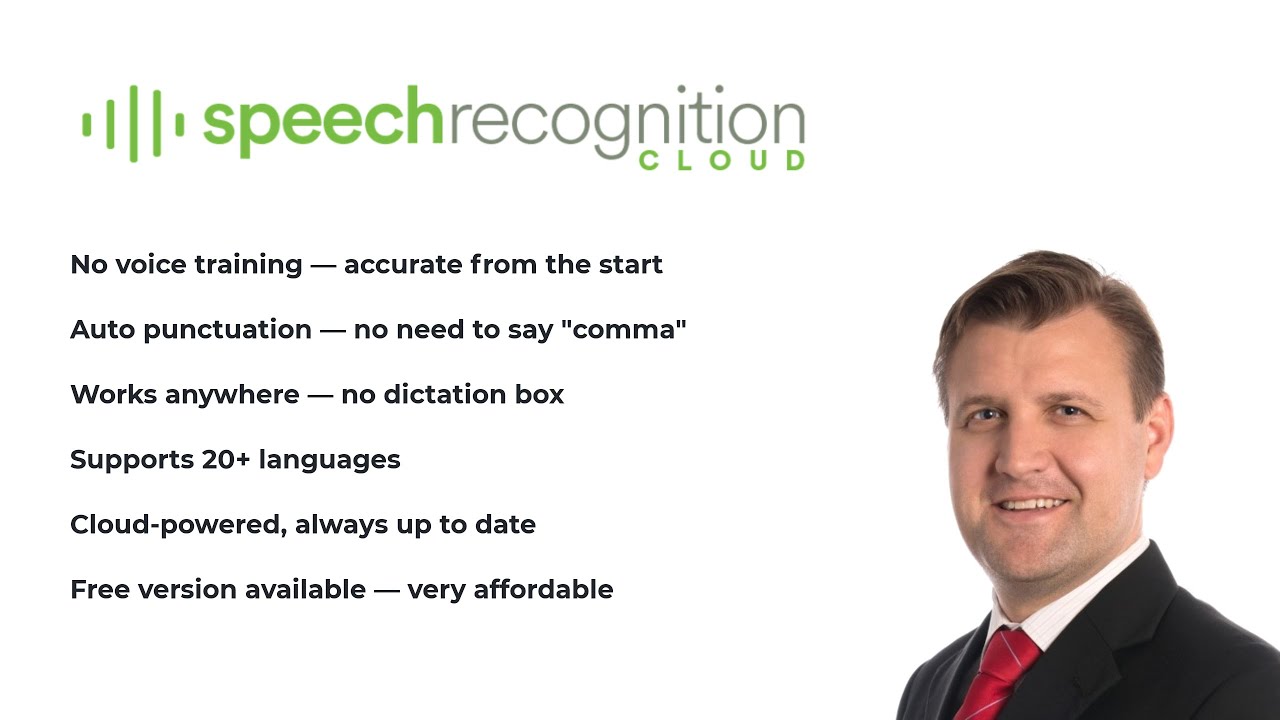
"I built Speech Recognition Cloud after 28 years of deploying speech technology for tens of thousands of professionals. I have watched what works, what frustrates people, and what they actually need. Legacy dictation systems are overpriced, overcomplicated, and overdue for replacement. This product is the answer for most users."
Speech Recognition Cloud adapts to your profession. Choose your field to see how it fits your workflow.
Free 30-day Medical Ultra trial. Specialised vocabulary, ultra accuracy, works with any EMR.
Learn more →
Voice dictation for nurses, radiologists, allied health, and healthcare administration.
Learn more →
Draft contracts, briefs, and case notes by voice. Confidentiality controls built in.
Learn more →
Emails, reports, and documentation at the speed of speech.
Learn more →
Secure dictation for policy, correspondence, and procurement documentation.
Learn more →
Essays, notes, and assignments faster. Affordable plans for students.
Learn more →
Lesson plans, reports, and correspondence without the typing.
Learn more →
Transcribe interviews, draft articles, and file stories faster.
Learn more →
Reduce keyboard use. An alternative input method for anyone with motor limitations.
Learn more →Dictate into any Windows application at your cursor. Word, Outlook, Chrome, EMRs, web forms. Anywhere you can type.
Install and start dictating immediately. No voice profiles, no calibration, no setup wizards.
Speak naturally. The AI adds punctuation, capitalisation, and formatting automatically.
Add specialised terms, names, and jargon. The system learns your terminology.
20+ voice commands for productivity. Auto-insert text blocks with templates.
Broad language support across Free, Personal, and Professional plans. Medical tier is English only.
Enhanced accuracy processing for Professional and Medical tiers. When precision matters most.
Audio is processed and not stored. Your data is never used for training. You stay in control.
Cloud AI handles accent variation well. Designed for real-world environments and diverse speakers.
Privacy is not a feature. It is how the product works.
Audio is processed in the cloud and immediately discarded after transcription
Transcribed text is delivered to your cursor and not stored on our servers
Your data is never used to train AI models
All connections are encrypted in transit
No audio recordings are saved at any point
Medical tier includes restricted AI modes for additional privacy
"It just works! Literally anyone can benefit from this. Just speak."
"Compared to my old dictation system, this is wild! Instantly accurate with no voice training."
"I don't know why I persisted with outdated expensive voice recognition software. This is the future."
"I can dictate into anything in Windows. It's that simple. And so much cheaper than the expensive medical dictation software I had."
"I used to struggle with expensive upgrades and complicated activation codes. SRC is simple, lightweight, and saves me hours every week."
"This is fast. I'm getting three times as much down as when I was typing. And no errors!"
"I don't even write briefs anymore. It just gets it."
"It just works! Literally anyone can benefit from this. Just speak."
"Compared to my old dictation system, this is wild! Instantly accurate with no voice training."
"I don't know why I persisted with outdated expensive voice recognition software. This is the future."
"I can dictate into anything in Windows. It's that simple. And so much cheaper than the expensive medical dictation software I had."
"I used to struggle with expensive upgrades and complicated activation codes. SRC is simple, lightweight, and saves me hours every week."
"This is fast. I'm getting three times as much down as when I was typing. And no errors!"
"I don't even write briefs anymore. It just gets it."
Start free, upgrade when you need more.
20 min/month. For students and occasional use.
Affordable unlimited dictation for study, work, and personal productivity.
For professionals who demand accuracy, speed, and advanced features.
Specialised for healthcare with medical vocabulary and ultra-high accuracy.
Pricing accurate at time of publication. Prices in USD and will convert to your local currency at checkout. Cancel anytime.
The genesis of Malayalam cinema in the mid-20th century was deeply intertwined with the social reform movements that swept through Kerala. Prior to the 1950s, Kerala society was rigidly stratified by caste and feudalism. The early decades of Malayalam cinema mirrored the anxieties and aspirations of a society in transition.
The search for "hot mallu reshma changing clothes in front of young guy extra quality" represents a demand for content that violates fundamental rights to privacy and dignity. No legitimate source provides such material because producing it would be criminal. Instead of pursuing harmful content, redirect that interest toward the vast, legitimate entertainment industry that respects performers and their privacy.
set high standards for subtle, natural acting that avoids the melodrama often found in other regional industries. Strong Scripts The genesis of Malayalam cinema in the mid-20th
For cinephiles, the 1980s represent the high watermark of Malayalam cinema. This era, led by visionaries like G. Aravindan, John Abraham, and Padmarajan (often stylized as P. Padmarajan), and later the screenplays of M. T. Vasudevan Nair, gave birth to what is now called "Middle Stream Cinema."
Dialogue in Malayalam cinema is a cultural artifact in itself. Unlike Hindi cinema’s Hindustani , Malayalam film dialogues are fiercely dialectical. A character from the northern Malabar region (Dileesh Pothan’s Thondimuthalum Driksakshiyum ) speaks a Malayalam rich with Arabic and Persian loanwords, distinct in rhythm and vocabulary from a central Travancore dialect (as heard in Kumbalangi Nights ), which is softer and peppered with anglicisms. The search for "hot mallu reshma changing clothes
Films like Newspaper Boy (1955) and Moodupani (1963) moved away from mythological themes to address social issues. The seminal film Chemmeen (1965), while a romantic tragedy, was essentially a cultural document. It captured the life of the fishing community, their folklore, and the collective conscience of the coast. This era established a precedent: cinema was to be a vehicle for social reflection, not just escapism.
The traditional Nair tharavadu —the large, matrilineal ancestral home with a central courtyard ( nadumuttam )—is an enduring icon of Kerala’s cultural identity. In classic films like Manichitrathazhu (1993), the grand, dilapidated tharavadu is the locus of trauma, family secrets, and a trapped spirit. The architecture itself—the locked room, the long corridors, the dark well—creates the film’s gothic horror. set high standards for subtle, natural acting that
Films like Kumbalangi Nights , The Great Indian Kitchen , and Maheshinte Prathikaaram dissect contemporary Kerala culture with surgical precision. They tackle deep-seated patriarchy, mental health, and modern relationships while remaining fiercely rooted in local micro-cultures. This seamless blend of hyper-local settings with universal human themes has allowed Malayalam cinema to transcend regional boundaries, earning widespread acclaim on national and international OTT platforms. Conclusion
As of the mid-2020s, Malayalam cinema is dominating the Indian OTT space. It is no longer a regional curiosity; it is the standard for intelligent Indian storytelling. Yet, the industry is not immune to the darker sides of Kerala culture: the rampant drug abuse among the youth (captured brutally in Bhoothakaalam ), the political extremism (navigated in Nayattu ), and the loneliness of the elderly (examined in Home ).
Directors like Fazil and Sathyan Anthikad perfected the "family drama"—a genre that is essentially a sociological study of the Malayali household. Films like Sandhesam (1991) satirized the factionalism of Kerala politics (the split between the Communist factions and the Congress), showing how ideology had been reduced to street hooliganism. The father figure in these films—usually wise, tired, and economically insecure—represented the "average Malayali" caught between his children’s greed and his own fading relevance.