
|
|
 |
|
Optitex Tutorial Pdf | TRENDING | | |
|
|
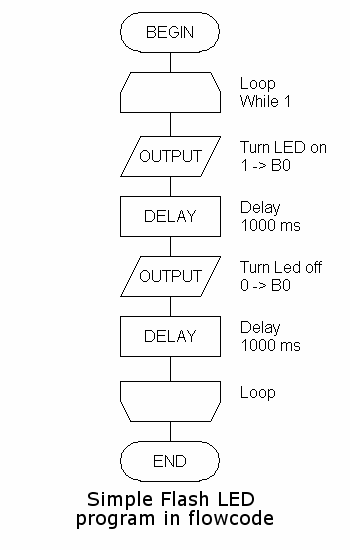
Optitex Tutorial Pdf | TRENDING |Published by Matrix Multimedia, Flowcode is a flow chart programming language. This makes flowcode an excellent introduction into programming PIC microcontrollers. Behind the scenes the flow chart is turned into C-code which is then compiled by SourceBoost Technologies BoostC compiler. The great advantage of Flowcode is that it allows those with little experience to create complex electronic systems in minutes. Optitex Tutorial Pdf | TRENDING |
Optitex Tutorial Pdf | TRENDING |Select your pattern pieces and assign them to a placement cylinder (e.g., wrap the front piece around the chest cylinder, wrap sleeves around the arm cylinders). Open the Fabric Content library. Assign a material type to your pattern (e.g., Denim, Cotton Jersey, Silk Chiffon). The software automatically loads real-world physical attributes like bending stiffness, weight, and stretch resistance. Digital pattern making has transformed the fashion and textile industries. Among the leading software solutions, Optitex stands out as a powerful tool for 2D pattern design, grading, and 3D garment simulation. optitex tutorial pdf Save your native work as .pds files. For factories using other CAD software (like Lectra or Gerber), export your files via File > Export using industry-standard formats like DXF-AAMA or ASTM . PDFs often provide a linear, chapter-by-chapter approach that ensures you don't miss fundamental concepts. Select your pattern pieces and assign them to Once your 2D pattern is ready, you can simulate it in 3D to see how it will look and fit on a virtual model. Need an Optitex tutorial PDF? This guide reviews the best resources, core skills (grading, 3D, nesting), and a step-by-step t-shirt lesson to master Optitex fast. Save your native work as Transitioning to digital pattern making with Optitex requires practicing basic drafting tools, understanding X/Y grading coordinates, and mastering virtual 3D assembly. By utilizing the steps outlined in this tutorial, you can drastically modernize your design pipeline. Ensure the direction arrows of both stitches match. If they cross, your fabric will twist inside out during simulation. If this happens, right-click the stitch line and select . Step 4: Running the Simulation Once all pieces are placed and stitched: Click the 3D Simulation Play button. |
|
Copyright © 2008 SourceBoost Technologies
| |