
Visual Audio Splitter & Joiner
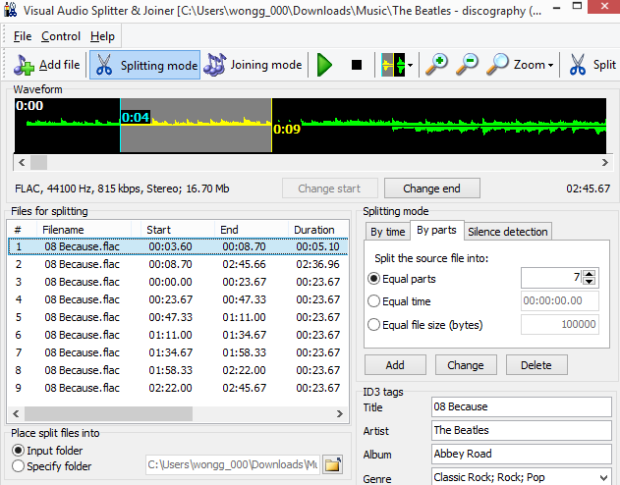
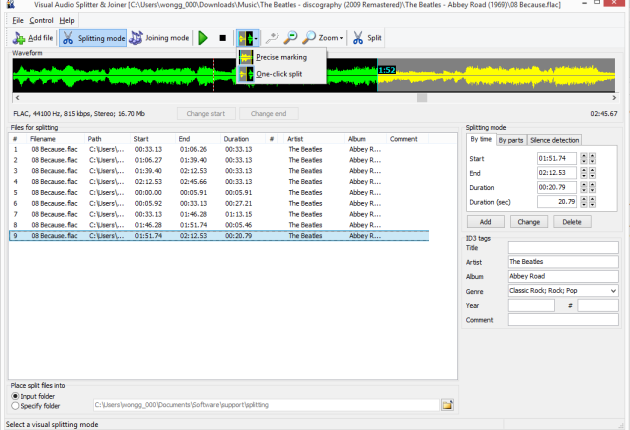
A handy software utility that can split and combine audio files. Cut files fast and easy using the waveform without losses in quality.


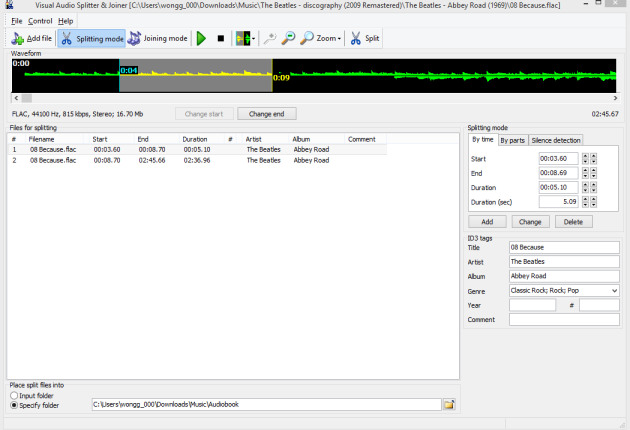
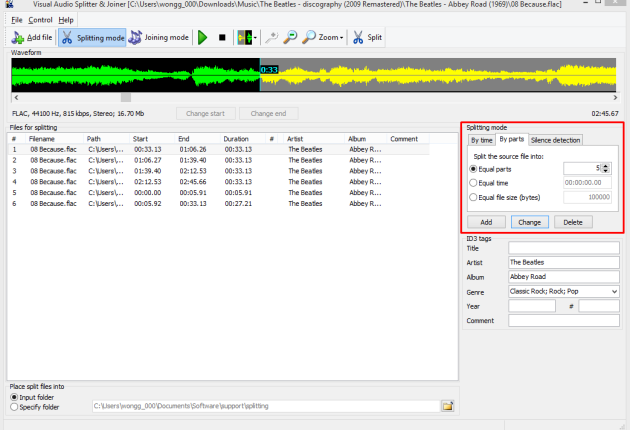
Split MP3, WMA, APE, and WAV files by a number of equal parts, by size, by duration. All the supported formats are split directly, without conversion!



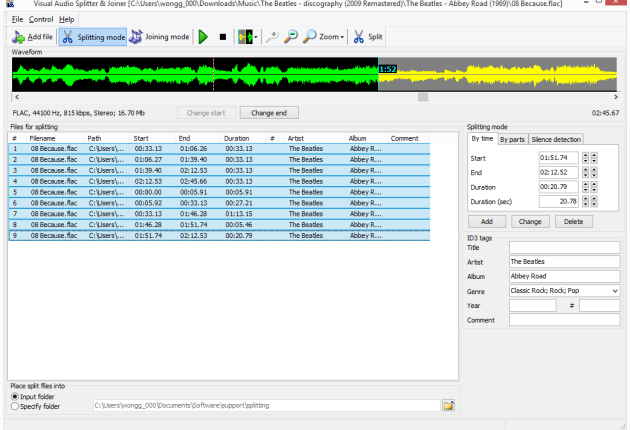
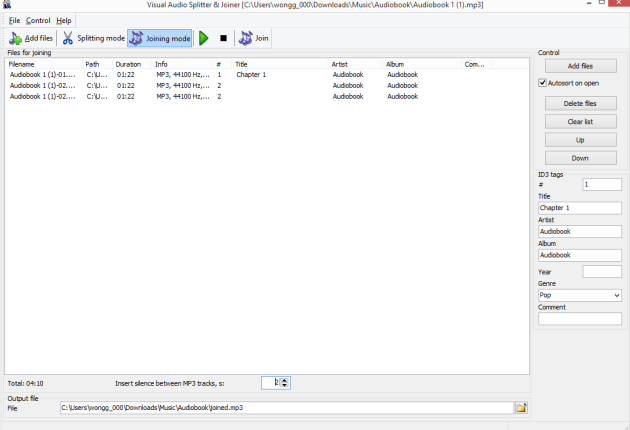
Visual Audio Splitter & Joiner allows you not only to split multiple audio files at once but also in any order. Join MP3, APE, WMA, and WAV files in any succession. Note that only parts in the same format can be merged. So if you want to merge files in different formats, you can convert them to the desired output format with AudioConverter Studio.

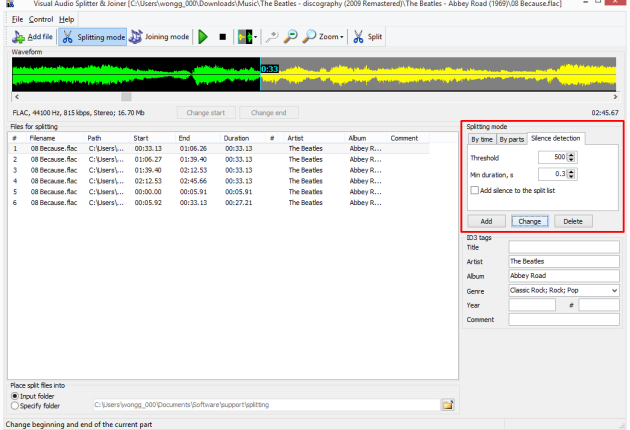
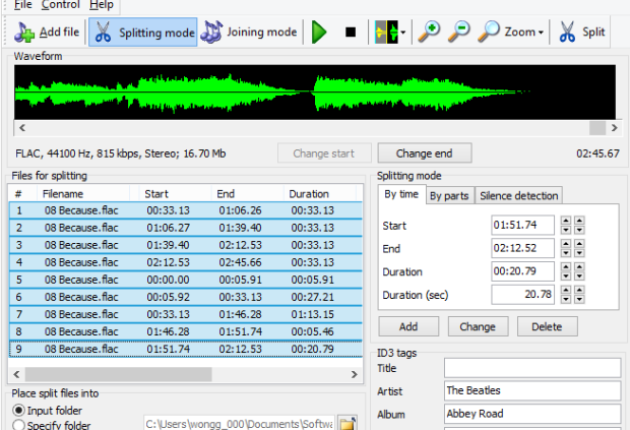
Suppose that you have an album of your favorite band in a single file and want to get easy access to each song. Visual Audio Splitter & Joiner is the right tool for this. In just a few seconds it will detect pauses between songs using the silence detection feature. All you need to do is to click the “Split” button. The MP3 splitter will deliver the result in virtually no time.

CUE files can be also used with media players. Nowadays many media players support CUE sheets either by using plugins or by initial design. CUE sheet is a simple text file (in ASCII encoding) which contains information concerning how audio tracks should be laid out on a CD.
Visual Audio Splitter & Joiner will help you create CUE sheets that will retain the detailed information. In this case, you don’t actually split the file but merely save the information about its parts into a CUE file.


Visual Audio Splitter & Joiner is so fast that you might ask: “Is it good for my files?”. The funny thing is, however, that Visual Audio Splitter & Joiner has absolutely no impact on quality.
BIOS stands for Basic Input/Output System. It is the low-level software stored on a ROM chip inside the console that initializes the hardware components (CPU, memory, GPU) and provides the essential functions for the console to boot up and run games. The BIOS is the first software executed when the console is powered on, performing system checks and preparing the hardware to load games.
Using the final USA v2.30 BIOS revision over older revisions (such as V1.00 or V2.00 from early fat models) offers distinct advantages for modern players:
If you encounter issues with this specific BIOS set, consider the following: scph90001biosv18usa230rom0 top
: It is generally considered legal to use a BIOS file only if you dump it from your own physical console . Downloading this file from "BIOS repositories" or ROM sites is technically copyright infringement.
When you acquire the BIOS set, you will likely find more than just the ROM0 file. For the best experience, place the full set into your emulator's bios directory. According to a popular Archive.org collection often referenced, the necessary files are: SCPH-90001_BIOS_V18_USA_230.ROM0 (Core file) SCPH-90001_BIOS_V18_USA_230.ROM1 SCPH-90001_BIOS_V18_USA_230.MEC SCPH-90001_BIOS_V18_USA_230.NVM Where to Find It BIOS stands for Basic Input/Output System
Interestingly, the "best" BIOS for playing backups is often the worst (least patched). But collectors want v18usa230 because it includes routines. LibCrypt was Sony’s advanced copy protection involving sub-channel data decoding. Dumping this BIOS allows emulator developers to finally emulate LibCrypt’s behavior perfectly, rather than hacking around it.
Standard SCPH-90001 units have a CD-ROM controller labeled "CXD2938Q" or "CXD2942R". The 230 microcode enables reading of "CD-RW" discs (though retail units were never certified for this). This was likely a test remnant left on late production lines. Using the final USA v2
The PlayStation 2 (PS2) is one of the most successful gaming consoles of all time, with over 155 million units sold worldwide. At the heart of the PS2's functionality is its complex firmware, which includes the Basic Input/Output System (BIOS). The BIOS plays a critical role in initializing hardware components during the boot process and providing a layer of abstraction for the operating system and applications. This paper focuses on a specific BIOS version identified as "SCPH90001BIOSV18USA230ROM0," exploring its implications, functionality, and significance within the PS2 ecosystem.
If you are trying to , I can help you: Understand the best settings for speed vs. graphics. Guide you on how to set up the controller . Explain how to dump your own BIOS legally.