Often, the manual demonstrates different ways to approach the same problem—such as using the method of sections versus the integration method—giving students a broader toolkit for exams. Key Topics Covered in the Manual
– Solutions using integration of bending moment, superposition, and Castigliano’s theorem (where applicable).
To transform the solution manual from a crutch into a springboard, follow the "Red, Yellow, Green" method:
$$I = \frac0.01 , \textm \times (0.02 , \textm)^312 = 6.67 \times 10^-8 , \textm^4$$
user wants a long article about the "solution manual for mechanics of materials 3rd edition roy r craig". This likely involves information about the textbook, its solutions manual, and possibly where to find it or its educational value. I need to gather relevant information. I'll perform multiple searches to cover different aspects: general info about the book, the solutions manual, availability, and perhaps academic context. I'll also search for the author. search results show various potential sources. To comprehensively address the user's request, I need to gather detailed information from the most relevant ones. I will open the Stanford catalog entry for the solutions manual, the Course Hero page, the vdoc.pub textbook page, the Chegg page, the Amazon page for the textbook, and the Duke library page. search results provide a variety of information. I need to structure a long article covering the textbook, the solutions manual, their value, and how to find them. I'll also need to cover the differences between the 3rd and 4th editions. I'll search for more details on the 4th edition. have gathered a substantial amount of information. The article will cover the textbook's approach, the features of the 3rd edition, the value and sources of the solutions manual, digital resources like Chegg, the differences from the 4th edition, and a conclusion. I will also cite the sources. Now I will write the article. search for a "solution manual for mechanics of materials 3rd edition roy r craig" is a common one for students navigating the complexities of this essential engineering course. However, the goal of finding these solutions is to truly understand the material, not just to get quick answers. This article serves as a comprehensive guide to Roy R. Craig's "Mechanics of Materials," 3rd Edition, exploring the invaluable role of its solution manual, where to find legitimate resources, and how to maximize your learning from this cornerstone textbook.
step-by-step solutions to textbook problems, emphasizing the use of free-body diagrams (FBDs) and systematic equilibrium equations
Understanding Mechanics of Materials (3rd Edition) by Roy R. Craig
Bending refers to the deflection of a member due to an applied load. Bending can result in curvature of the member.
Mechanics of materials—often called strength of materials—is a foundational branch of engineering. It focuses on analyzing stress, strain, and deflection in structural components.
Do you prefer or step-by-step equations ?
The 3rd edition follows a "four-step problem-solving methodology" (Plan the Solution, Review the Solution, etc.) to analyze the behavior of solid materials. Key chapters include: Introduction to Mechanics; Stress and Strain. Chapter 3-4: Axial Deformation and Torsion.
Determine the ductility of the steel specimen.
Fundamental concepts and definitions.

EagleEye Director II имеет встроенное обновляемое программное обеспечение. Обновление программного обеспечения происходит автоматически при подключении к кодеку, либо во время обновления ПО кодека. Также можно смостоятельно произвести обновление встроеного ПО.
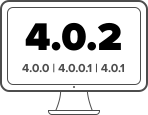
РАБОТА ДОСТУПНА с версии 4.1 Если после восстановления заводских настроек система сбрасывается до версий ПО 4.0.0, 4.0.0.1 или 4.0.1, то сначала следует установить версию 4.0.2, после чего обновляться на более поздние версии.
Для получения других файлов обновлений (Download Firmware), а также всей технической документации посетите страницу продукта на портале support.hp.com
Often, the manual demonstrates different ways to approach the same problem—such as using the method of sections versus the integration method—giving students a broader toolkit for exams. Key Topics Covered in the Manual
– Solutions using integration of bending moment, superposition, and Castigliano’s theorem (where applicable).
To transform the solution manual from a crutch into a springboard, follow the "Red, Yellow, Green" method:
$$I = \frac0.01 , \textm \times (0.02 , \textm)^312 = 6.67 \times 10^-8 , \textm^4$$ Often, the manual demonstrates different ways to approach
user wants a long article about the "solution manual for mechanics of materials 3rd edition roy r craig". This likely involves information about the textbook, its solutions manual, and possibly where to find it or its educational value. I need to gather relevant information. I'll perform multiple searches to cover different aspects: general info about the book, the solutions manual, availability, and perhaps academic context. I'll also search for the author. search results show various potential sources. To comprehensively address the user's request, I need to gather detailed information from the most relevant ones. I will open the Stanford catalog entry for the solutions manual, the Course Hero page, the vdoc.pub textbook page, the Chegg page, the Amazon page for the textbook, and the Duke library page. search results provide a variety of information. I need to structure a long article covering the textbook, the solutions manual, their value, and how to find them. I'll also need to cover the differences between the 3rd and 4th editions. I'll search for more details on the 4th edition. have gathered a substantial amount of information. The article will cover the textbook's approach, the features of the 3rd edition, the value and sources of the solutions manual, digital resources like Chegg, the differences from the 4th edition, and a conclusion. I will also cite the sources. Now I will write the article. search for a "solution manual for mechanics of materials 3rd edition roy r craig" is a common one for students navigating the complexities of this essential engineering course. However, the goal of finding these solutions is to truly understand the material, not just to get quick answers. This article serves as a comprehensive guide to Roy R. Craig's "Mechanics of Materials," 3rd Edition, exploring the invaluable role of its solution manual, where to find legitimate resources, and how to maximize your learning from this cornerstone textbook.
step-by-step solutions to textbook problems, emphasizing the use of free-body diagrams (FBDs) and systematic equilibrium equations
Understanding Mechanics of Materials (3rd Edition) by Roy R. Craig This likely involves information about the textbook, its
Bending refers to the deflection of a member due to an applied load. Bending can result in curvature of the member.
Mechanics of materials—often called strength of materials—is a foundational branch of engineering. It focuses on analyzing stress, strain, and deflection in structural components.
Do you prefer or step-by-step equations ? I'll also search for the author
The 3rd edition follows a "four-step problem-solving methodology" (Plan the Solution, Review the Solution, etc.) to analyze the behavior of solid materials. Key chapters include: Introduction to Mechanics; Stress and Strain. Chapter 3-4: Axial Deformation and Torsion.
Determine the ductility of the steel specimen.
Fundamental concepts and definitions.