 a journal of interesting technical ideas . . . a journal of interesting technical ideas . . .
This is a long post, but most of it is file contents. Keep reading!
GNS3 appliance files are descriptions of virtual machines used in network simulations. The appliance files have suffixes of .gns3a and are included with the GNS3 download. You can update the files and create new ones. The goal of this article is to walk through the process of working with appliance files and contributing them back to the community.
On a personal note, submitting a new GNS3 appliance was the first time I contributed to an open-source project. I’m still learning, but a few years ago I knew nothing. Jeremy Grossman, with GNS3, was patient and helped me understand the process of using Git. Contributing - even in this minor way - was a real high for me and I’d love for you to be able to share that feeling and contribute to this and other projects. GNS3a was my “gateway drug” into being a contributor and not just a consumer of open source.
One of the files I’ve contributed is the Security Onion appliance. Security Onion is a Linux distribution that focuses on security tools. Below is the current version (9/1/20) of the GNS3A file. Before we create a new appliance, let’s update this one.
Tropes are the shorthand of storytelling. Far from being cheap clichés, well-executed tropes tap into universal psychological dynamics. Here are a few that have dominated romantic storylines for generations:
In the pantheon of human experience, nothing is as universally pursued, meticulously analyzed, or creatively depicted as love. From the cave paintings of ancient courtships to the algorithmic swiping of modern dating apps, the desire for connection remains the silent engine of our species. Yet, when we sit down to watch a film, binge a series, or read a novel, we are rarely satisfied with a simple depiction of two people getting along. We want the storm. We want the arc.
If there are no obstacles, there is no story. Internal conflict (fear of commitment, past trauma) and external conflict (war, family rivalries, distance) keep the audience rooting for the couple.
As she entered the store, she noticed a tall, dark-haired man standing by the fiction section, intently reading a novel. Emma couldn't help but notice the way his eyes lit up as he turned the pages. She felt a sudden jolt of curiosity and found herself wondering who this stranger was and what he was reading.
A major misunderstanding, a secret revealed, or an external crisis forces the couple apart. This is the lowest emotional point of the narrative, where a future together seems entirely impossible.
These are great for building anticipation throughout the day without being too graphic. "I can’t stop thinking about last night."
Stranding characters together in an isolated setting removes their ability to escape emotional confrontation, accelerating intimacy.
I can expand this piece further depending on your specific needs. Let me know if you would like to focus on:
The audience must understand exactly what the characters risk losing if they give in to love—be it their independence, their safety, their social standing, or their existing peace of mind.
The Architecture of Heartstrings: Why Relationships and Romantic Storylines Define Modern Fiction
Most of this is pretty straight forward. The structure looks like:
A descriptive section
Next is the Qemu section that describes how the VM environment should be constructed. This is straightforward as well. Console types are VNC or telnet. You may have to try different ethernet adapters to see what works, but I recommend starting with the Intel e1000 because this model is supported by most VMs. Using a para-virtualized adapter may give better performance, so you may also want to try vmxnet3. Most architectures will be 64bit and RAM requirements will usually be on the website.
That leaves two sections - Images and Versions. There should be a matching entry in both places. The images section is a list of virtual hard drives and CD-ROM images to use in the VM and includes:
Let’s update this file. There are a lot of old images listed as options. I’ll remove the image and version sections for 14.04.5.3 and add the most recent (16.04.7.1). That will leave users with the last 14.x and two images in 16.x including the latest. Whether dealing with a distribution or a commercial image, changes made between versions may introduce new processes or bugs so leaving some older images gives users an easy workaround. Here’s the updated file. Scroll below the output for a discussion of submitting this back to the project.
Tropes are the shorthand of storytelling. Far from being cheap clichés, well-executed tropes tap into universal psychological dynamics. Here are a few that have dominated romantic storylines for generations:
In the pantheon of human experience, nothing is as universally pursued, meticulously analyzed, or creatively depicted as love. From the cave paintings of ancient courtships to the algorithmic swiping of modern dating apps, the desire for connection remains the silent engine of our species. Yet, when we sit down to watch a film, binge a series, or read a novel, we are rarely satisfied with a simple depiction of two people getting along. We want the storm. We want the arc.
If there are no obstacles, there is no story. Internal conflict (fear of commitment, past trauma) and external conflict (war, family rivalries, distance) keep the audience rooting for the couple. www sexy videos d
As she entered the store, she noticed a tall, dark-haired man standing by the fiction section, intently reading a novel. Emma couldn't help but notice the way his eyes lit up as he turned the pages. She felt a sudden jolt of curiosity and found herself wondering who this stranger was and what he was reading.
A major misunderstanding, a secret revealed, or an external crisis forces the couple apart. This is the lowest emotional point of the narrative, where a future together seems entirely impossible. Tropes are the shorthand of storytelling
These are great for building anticipation throughout the day without being too graphic. "I can’t stop thinking about last night."
Stranding characters together in an isolated setting removes their ability to escape emotional confrontation, accelerating intimacy. From the cave paintings of ancient courtships to
I can expand this piece further depending on your specific needs. Let me know if you would like to focus on:
The audience must understand exactly what the characters risk losing if they give in to love—be it their independence, their safety, their social standing, or their existing peace of mind.
The Architecture of Heartstrings: Why Relationships and Romantic Storylines Define Modern Fiction
In GNS3, go to File > Import Appliance and make sure that your appliance imports correctly. GNS3 will provide guidance if there’s a formatting error. Looking at the JSON above, you can imagine that a common mistake is unmatched brackets!
If the GNS3a file loads, test it by creating an instance. You need to test at least any new versions you added. Make sure the appliance boots without error and that expected interfaces are available.
Once the pieces are working, submit the appliance to the community by cloning the GNS3-registry on Github and adding in your file.
git clone https://github.com/GNS3/gns3-registry.git
If you’ve already cloned it, make sure that your branch is up to date. Upstream is the original source (in this case the GNS3 copy).
git fetch upstream
Two Python programs are included in the repo. Run them both on your copy before continuing. These are QA processes that look for issues before you submit. They will take a little time to run.
pip3 install -r requirements.txt   # this does __pip3 install jsonschma__ and __pip3 install pycurl__
python3 check.py
python3 check_url.py
Next push your local copy to your github copy. In Github terms, origin is your copy on Github, and master is the local copy.
git add .
git commit -m "Updated Security Onion"
git push -f origin master
Now we have an up to date local copy of the gns3-registry that includes our updated gns3a appliance and we’ve updated our fork on Github. Next, we offer our update to the project via a Pull Request. You are going to be one of the cool kids!
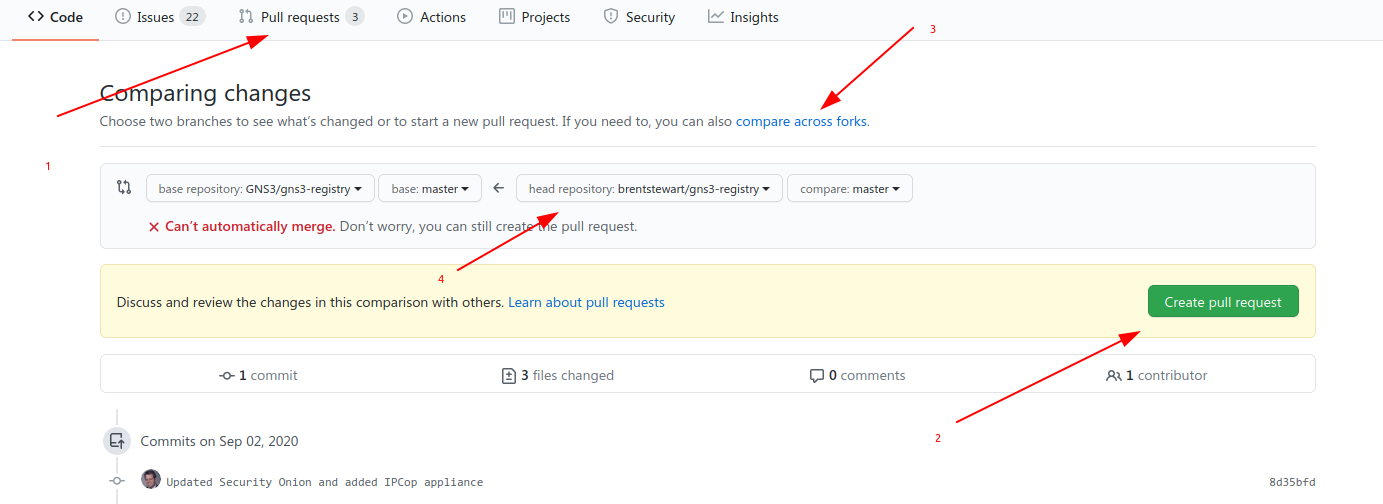 Go to the gns3-registry repository on Github and select the Pull Requests tab and click the big green New pull request button. Under Compare, select the link to compare across forks (since your copy is a fork) and select your fork. It should show you the changes to files so take a moment to digest that and make sure this PR is doing what you want. Finally, submit the Pull Request. Github will email you when there’s an update to the request. If the GNS3 team has a question, they’ll submit a comment on the PR and leave it open for you to resolve. Otherwise, it will get merged in and all the other GNS3 users will be able to enjoy your hard work!
Thanks!