Contents

Top
Command Line Options
Keyboard Shortcuts
Configuration File
Main Window Settings
Wrap Settings
Export Settings
Auto Probe Settings
General Settings

Script Patched — Zxdl

G-Code Ripper Home Download Scorch Works Home

Command Line Options

Usage python g-code_ripper-XXX.py [-g file ]
or
g-code_ripper-XXX.py [-g file ]
-c
(or --config_file)
Configuration file to read
-g
(or --gcode_file)
g-code file to read
-d
(or --defdir)
Default open/save directory
-h
(or --help)
print syntax help to console window.
Example
(Using python script with
preinstalled python distribution)
python g-code_ripper-XXX.py -g my_file.ngc
Example
(Using precompiled
Windows executable)
g-code_ripper-XXX.exe -g my_file.ngc

Keyboard Shortcuts

F1 Open the Help dialog box. (There is nothing in the help except a reference back to the web page and my e-mail address)
F2 Opens General Settings Window
F5 Refresh display

Configuration File

g-code-ripper_config.ngc
or
.gcoderipperrc
When G-Code Ripper starts up the directory in which G-Code Ripper starts in is searched for a file named "g-code-ripper_config.ngc". If the file is found it is read and all of the G-Code Ripper options are set according to the settings saved in the config file. After searching for the config file in the current directory the users home directory is searched for "g-code-ripper_config.ngc" or ".gcoderipperrc" if either of these are found it will be used as the default settings. Only the first config file found is read.

To create a config file with your preferred options for startup just open G-Code Ripper and change the settings to your liking and click the save button next to configuration file in the settings window.

Main Window

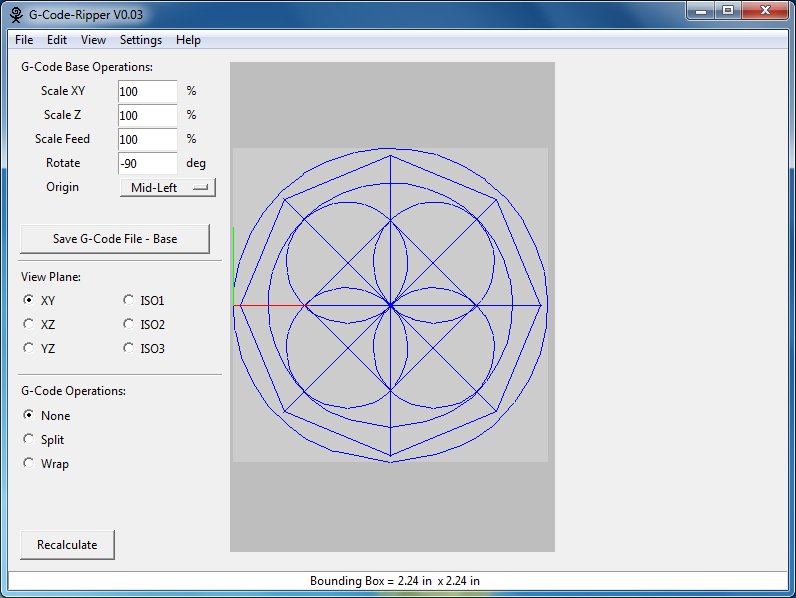
G-Code Ripper - Main Window

G-Code Base Operations: This section contains basic operations that are performed prior to any G-Code Operations selected below. The base operations are always applied before the additional operations.
Scale XY Sets the scaling percentage for X and Y axes to be applied to the input g-code file.
Scale Z Sets the scaling percentage for Z axis to be applied to the input g-code file.
Scale Feed Sets the scaling percentage for feed rate to be applied to the input g-code file.
Rotate Sets the angle in degrees to rotate input g-code file.
Origin The origin determines the relative location of the g-code x and y zero location. The current location of the origin is displayed in the display window as a red and green lines. The red and green lines follow the RGB convention Red is the x-axis, Green in the y-axis.
Save G-Code File Base (Button) This button results in saving the g-code with only the option above the button being applied (scale, rotate, origin). Any further options from below or on the right side of the image are not applied.
View Plane: This section contains a variety of view plane orientations only one of the options is active at any time.
G-Code Operations: In this section the additional operations that can be applied to the g-code can be selected.
None No operations are performed in addition to the base operations.
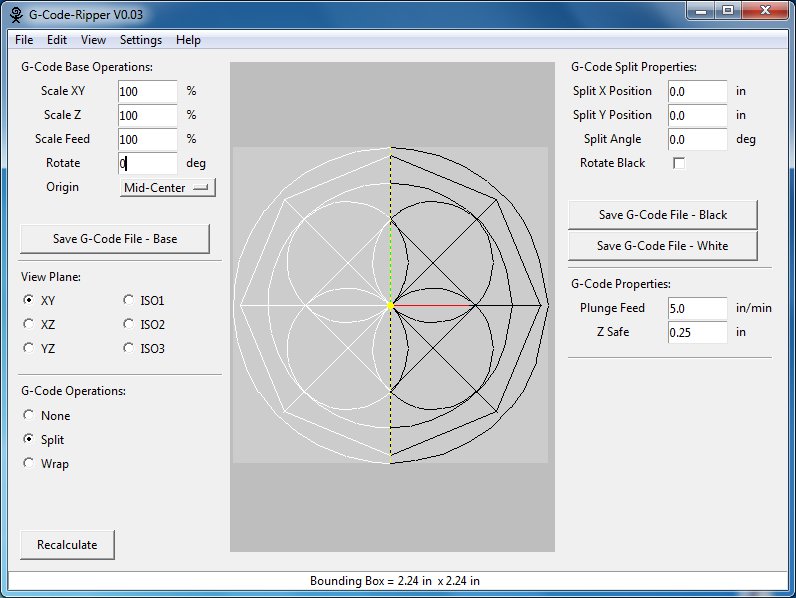
Split The G-Code is split along a line creating two g-code programs that can be run independently.
Wrap One of the G-Code linear axes (X or Y) is mapped to a rotary axis (A or B) for machining on a cylinder.

G-Code Split Properties

zxdl script patched

Input Field Description
Split X Position X position of the splitting line. (i.e. the line on which the g-code is divided into two parts.) The X position is measured from the origin set in the base operations section.
Split Y Position Y position of the splitting line. (i.e. the line on which the g-code is divided into two parts.) The Y position is measured from the origin set in the base operations section.
Split Angle The angle of the splitting line.
Rotate Black The rotate black setting determines whether one of the two sides of the split will be rotated by 180 degrees. Rotating 180 degrees allows the stock to be rotated 180 degrees in the machine to machine the second half. Doing this process can effectively increase size of designs that can be cut by a given machine.
Save G-Code File-Black (Button) This button saves the g-code displayed as black in the canvas.
Save G-Code File-White (Button) This button saves the g-code displayed as white in the canvas.
Plunge Feed Because the g-code is being split additional cut starts and stops are required. During the additional starts the tool needs to plunge into the stock material. The plunge feed sets the feed rate for these new moves into the stock material.
Z Safe Because the g-code is being split additional cut starts and stops are required. After one of the additional cut stops the tool needs to move to a safe position for rapid movement. The Z Safe setting sets the z position of this z location that is safe for rapid motions.

Script Patched — Zxdl

: Endpoints used by older ZXDL scripts were completely deprecated or gated behind cryptographic tokens.

Unlike basic macros or standard tools like the OP Auto Clicker , the ZXDL script injected custom code directly into application processes. This allowed users to execute highly complex commands with zero latency, bypass standard server-side checks, and automate tasks that usually require hours of manual input.

Many popular script executors now crash or close instantly when trying to run the patched ZXDL code.

Because the zx library natively provides helpful wrappers around shell processes and automatically escapes arguments, developers found it incredibly easy to write stable, high-performance execution blocks to interact with vulnerable APIs. Why Was the ZXDL Script Patched? zxdl script patched

Repeat offenders are finding their entire machines hardware-banned, blocking future access regardless of account switching.

Anti-cheat software identifies specific strings of code unique to the ZXDL script. Once blacklisted, the system automatically blocks any execution attempt.

In competitive gaming or high-frequency digital tasks, the script offered an undeniable, almost invisible advantage. Its underlying architecture operated silently in the background, making it incredibly difficult for standard anti-cheat algorithms and integrity monitors to detect. How the Defences Evolved: Anatomy of the Patch : Endpoints used by older ZXDL scripts were

If you need help resolving a specific error or updating a codebase, please share your , the target platform you are connecting to, or the programming language you prefer to work with. Share public link

The cat-and-mouse game between web developers and automation scripters is continuous. To ensure your workflows never experience sudden downtime, always enable features within your script manager. Furthermore, keeping an eye on development forks ensures you are the first to know when a new workaround goes live. To help narrow down your setup, let me know:

: Behavioral limit hit due to unthrottled thread execution. Many popular script executors now crash or close

Now that the specific ZXDL exploit path is patched, developers must shift their engineering practices away from simple payload spoofing toward legitimate or highly adaptable automation frameworks. Alternative Strategy Core Mechanism Best Used For Authenticated tokens via platform developer consoles. Stable, legal, enterprise-grade data pipelines. Playwright / Puppeteer Real, headful browser automation with extensions.

: "ZXDL" could refer to a specific software tool, script, or system. Without more context, it's hard to say exactly what ZXDL stands for or what it does. It could be related to a project, a protocol, a software component, or something else entirely.

The zxdl script was typically associated with:

[User Request via ZXDL] ----> ( Bypassed Client-Side Validation ) ----> [Server Data Leak] | V [FIX: Server-Side Patch Deployed] | [User Request via ZXDL] ----> ( Dropped / Forbidden 403 ) ----------> [System Secure] 1. Server Resource Depletion

Now I will write the article. The Definitive Guide to the “zxdl script patched” Phenomenon
Export (DXF, CSV) Settings

zxdl script patched

Input Field Description
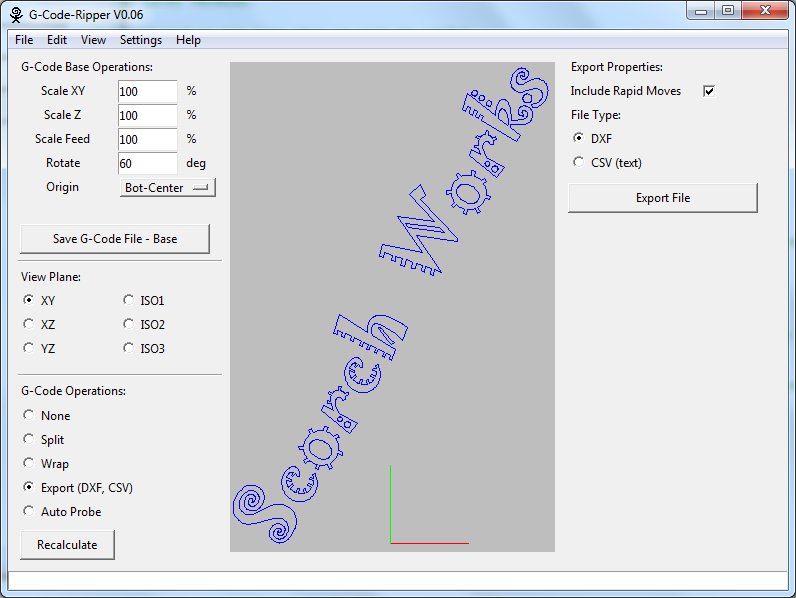
Include Rapid Moves If selected the rapid moves will be included in the exported output.
File Type Select the type of file to be exported

Auto Probe Settings

zxdl script patched

Input Field Description
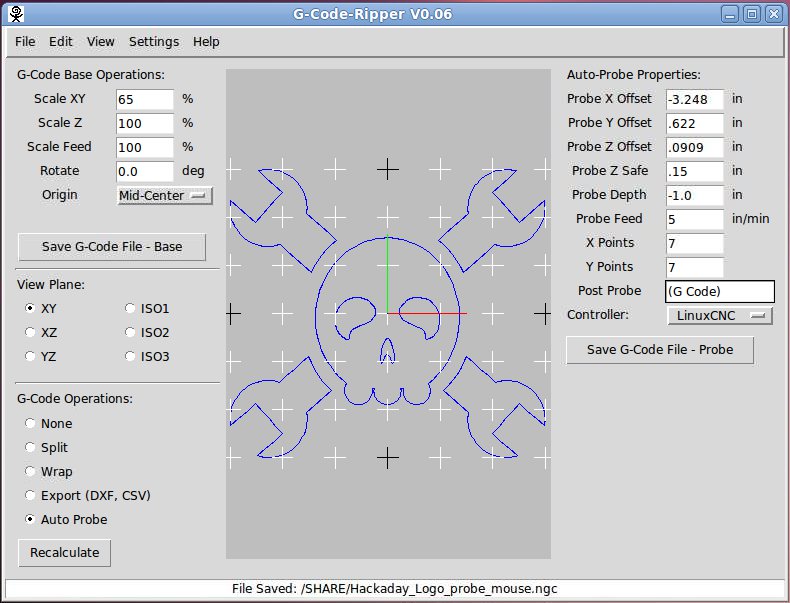
Probe X Offset X distance from the tool to the probe.
(if the tool is the probe this should be set to zero)
Probe Y Offset Y distance from the tool to the probe.
(if the tool is the probe this should be set to zero)
Probe Z Offset Z distance from the tool to the probe.
(if the tool is the probe this should be set to zero)
(It is best to keep this value as close to zero as possible to prevent crashing the tool or probe)
Probe Z Safe This is the safe Z height when probing (When the probe is over the work piece).
Be aware of where the tool will be when the probe is at this position to avoid cashing the tool.
Probe Depth Max Depth the probe will travel attempting to detect the work piece.
If the probe travels to this position and does not detect the part an error will occur.
Probe Feed The feed rate for the probe when it is lowering to detect the part.
X Points This is the number of points that form the grid of probe points in the X direction.
Points that are not needed (too far from tool path) are displayed as black in the preview canvas and will not probed.
Y Points This is the number of points that form the grid of probe points in the Y direction.
Points that are not needed (too far from tool path) are displayed as black in the preview canvas and will not probed.
Post Probe This is a text entry field for any G-Codes that should be executed prior to the pause between probing and cutting.
(If you want to swap the probe head for the tool head you may want to raise to a specified Z height (i.e. G0Z5.0)
Controller Set the CNC controller to be used. LinuxCNC and MACH3 are supported. They require different codes for probing etc.

: Endpoints used by older ZXDL scripts were completely deprecated or gated behind cryptographic tokens.

Unlike basic macros or standard tools like the OP Auto Clicker , the ZXDL script injected custom code directly into application processes. This allowed users to execute highly complex commands with zero latency, bypass standard server-side checks, and automate tasks that usually require hours of manual input.

Many popular script executors now crash or close instantly when trying to run the patched ZXDL code.

Because the zx library natively provides helpful wrappers around shell processes and automatically escapes arguments, developers found it incredibly easy to write stable, high-performance execution blocks to interact with vulnerable APIs. Why Was the ZXDL Script Patched?

Repeat offenders are finding their entire machines hardware-banned, blocking future access regardless of account switching.

Anti-cheat software identifies specific strings of code unique to the ZXDL script. Once blacklisted, the system automatically blocks any execution attempt.

In competitive gaming or high-frequency digital tasks, the script offered an undeniable, almost invisible advantage. Its underlying architecture operated silently in the background, making it incredibly difficult for standard anti-cheat algorithms and integrity monitors to detect. How the Defences Evolved: Anatomy of the Patch

If you need help resolving a specific error or updating a codebase, please share your , the target platform you are connecting to, or the programming language you prefer to work with. Share public link

The cat-and-mouse game between web developers and automation scripters is continuous. To ensure your workflows never experience sudden downtime, always enable features within your script manager. Furthermore, keeping an eye on development forks ensures you are the first to know when a new workaround goes live. To help narrow down your setup, let me know:

: Behavioral limit hit due to unthrottled thread execution.

Now that the specific ZXDL exploit path is patched, developers must shift their engineering practices away from simple payload spoofing toward legitimate or highly adaptable automation frameworks. Alternative Strategy Core Mechanism Best Used For Authenticated tokens via platform developer consoles. Stable, legal, enterprise-grade data pipelines. Playwright / Puppeteer Real, headful browser automation with extensions.

: "ZXDL" could refer to a specific software tool, script, or system. Without more context, it's hard to say exactly what ZXDL stands for or what it does. It could be related to a project, a protocol, a software component, or something else entirely.

The zxdl script was typically associated with:

[User Request via ZXDL] ----> ( Bypassed Client-Side Validation ) ----> [Server Data Leak] | V [FIX: Server-Side Patch Deployed] | [User Request via ZXDL] ----> ( Dropped / Forbidden 403 ) ----------> [System Secure] 1. Server Resource Depletion

Now I will write the article. The Definitive Guide to the “zxdl script patched” Phenomenon